Data Center Fabric Evolution
Compare bridged redundancy, Layer 2 fabrics and routed leaf–spine transport before choosing the overlay design.
From a hierarchy to a fabric
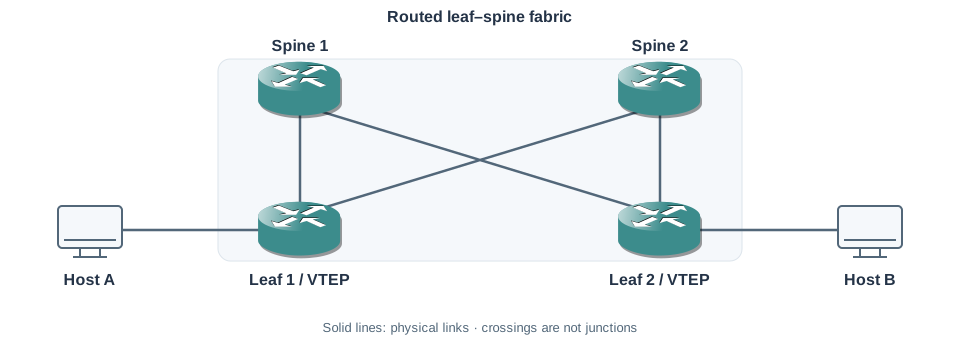
Access, aggregation and core roles organize a traditional data-center hierarchy. A server-to-server flow crossing access blocks may travel through several aggregation stages. A leaf–spine fabric instead connects each leaf to every spine in its fabric: hosts attach to leaves and spines provide transit. The common different-leaf path is leaf → spine → leaf, with one transit spine, not a promise that every possible fabric has only two IP hops.
Bridged redundancy and spanning tree
A bridged topology can loop frames because Ethernet has no IP-style hop limit. Spanning tree selects a loop-free active topology; a redundant physical path may be blocked for an instance. RSTP improves the transition process and MSTP groups VLANs into instances. Different instances can use different links, but that does not make every path active for one instance.
STP is still useful on access networks. A routed fabric changes the transit forwarding model rather than proving that no loop protection is needed anywhere. Broadcast containment, storm control and endpoint attachment remain operational concerns.
Use more links without building a new overlay
| Approach | What it combines | Boundary |
|---|---|---|
| Link aggregation | Parallel links between compatible logical endpoints | A flow hash usually selects one member; one flow does not gain the sum of all member speeds. |
| Chassis virtualization | Physical devices with a coordinated logical-switch view | Control-plane and failure behavior depend on the implementation. |
| Multi-chassis aggregation | A LAG attached across cooperating devices | Peer consistency and split-brain handling are critical; it does not remove all VLAN or flooding limits. |
These approaches improve access redundancy and bandwidth. They do not by themselves provide a 24-bit tenant identifier or transform a bridged core into an IP underlay.
Layer 2 fabrics: a different forwarding model
| Technology | Conceptual direction |
|---|---|
| TRILL | Link-state routing with RBridge encapsulation and a hop count for Ethernet transport. |
| FabricPath | A platform-specific routed Layer 2 fabric architecture. |
| Shortest Path Bridging | IEEE link-state Ethernet bridging, including MAC-in-MAC service models. |
These are distinct technologies, not different names for VXLAN. Deployment footprint and support vary. Treat older fabrics as architecture context and verify the actual platform lifecycle rather than assuming every implementation has disappeared.
IP fabric with an edge overlay
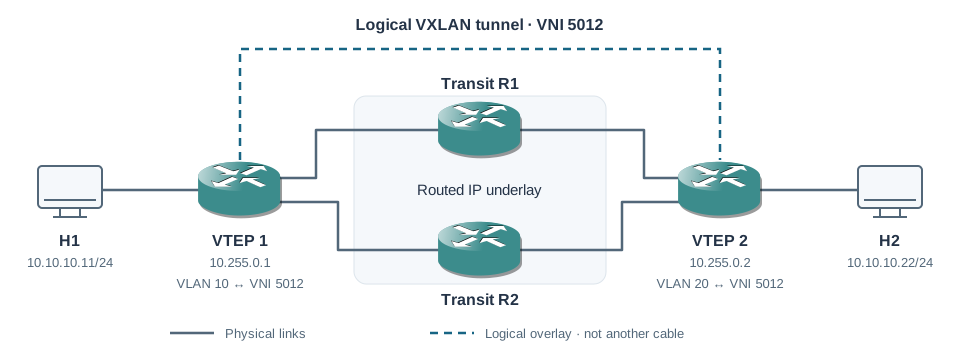
Move transport reachability to routed links, then terminate tenant services at the edges. Transit routers need routes to VTEP addresses; they do not need every tenant MAC. VXLAN supplies the Ethernet-in-UDP data plane. An IP underlay can use ECMP when routes and platform support permit it, while the overlay preserves a chosen tenant segment.
Adding a leaf adds endpoint capacity and consumes spine ports. Adding a spine can add aggregate transport capacity, subject to link speeds, radix and cabling. Oversubscription still depends on host-facing demand versus uplink capacity; a leaf–spine drawing alone proves no throughput guarantee.
Learning and EVPN are separate choices
Flood-and-learn VXLAN learns endpoint locations from traffic and needs BUM replication, historically using multicast and also implementable with ingress replication. EVPN can advertise MAC/IP reachability through BGP and add mobility and multihoming procedures. EVPN does not eliminate every broadcast or unknown destination, so replication policy still matters.
The implementation lessons follow this progression: static ingress replication, multicast learning, EVPN Layer 2, then routed tenant services and ARP suppression. Underlay protocol examples follow as separate deployments. This introduction does not require a specific platform configuration.
Choose by evidence, not only by diagram
| Check | Useful evidence |
|---|---|
| Redundancy | Withdraw one path and inspect actual convergence and loss. |
| Capacity | Compare uplink and server demand; test the forwarding hash with multiple flows. |
| Isolation | Verify tenant/segment membership and unwanted reachability tests. |
| Operations | Trace access frame → overlay lookup → routed transport → remote delivery. |
Record platform support, software release, failure domain and recovery procedure before deployment. All topologies and forwarding descriptions here are illustrative architecture examples, not measured throughput or recovery results.
Further reading
Key Takeaways
- A leaf–spine fabric offers predictable transit choices between leaves.
- Spanning tree, LAG and multi-chassis aggregation solve different redundancy problems.
- TRILL, FabricPath and SPB are distinct Layer 2 fabric approaches.
- VXLAN places tenant service at edges while routed transit carries VTEP packets.
- EVPN distributes reachability but does not remove the need to plan BUM handling.