Spanning-tree limitations
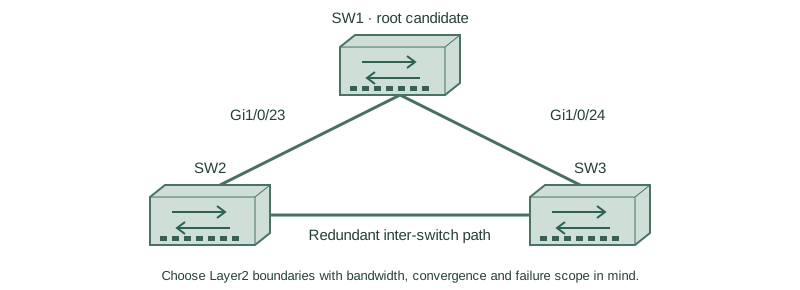
Choose Layer2 boundaries with bandwidth, convergence and failure scope in mind.
Independent lab examples; selected output and frame summaries are illustrative. Port naming and command support vary by switch and software release.
Network and objective
Classic PVST+ is used to expose original STP behavior; rapid-PVST+ and MST are separate lessons.
Use three fresh isolated switches with Gigabit trunks: SW1 Gi1/0/23 ↔ SW2 Gi1/0/23; SW1 Gi1/0/24 ↔ SW3 Gi1/0/24; SW2 Gi1/0/24 ↔ SW3 Gi1/0/23. Both VLANs10/20 exist on every switch. Baseline SW1/SW2/SW3 priorities are4096/8192/12288, with short costs and no extra links. Start independently from the included baseline for each lesson; subsequent repair snippets apply to the named device.
How it works
One tree creates a loop-free path but can leave redundant capacity idle for a particular VLAN. Different PVST/MST roots can distribute VLAN groups; they do not deliver arbitrary per-flow ECMP within a single tree. Traffic can follow a root-oriented path that is not the shortest path between a particular pair of hosts.
Large stretched broadcast domains also enlarge flooding and failure scope. Rapid STP improves recovery conditions but does not eliminate control loss, misconfiguration or every outage. Designs can use routed access/fabric ECMP or engineered multichassis aggregation where supported; these introduce their own operational and control-plane requirements.
Configure or inspect
SW1
vlan 10
vlan 20
spanning-tree mode rapid-pvst
spanning-tree pathcost method short
spanning-tree vlan 10 priority 4096
spanning-tree vlan 20 priority 4096
interface range GigabitEthernet1/0/23 - 24
 switchport mode trunk
 switchport trunk allowed vlan 10,20
 switchport nonegotiate
 no shutdown
exit
SW2
vlan 10
vlan 20
spanning-tree mode rapid-pvst
spanning-tree pathcost method short
spanning-tree vlan 10 priority 8192
spanning-tree vlan 20 priority 8192
interface range GigabitEthernet1/0/23 - 24
 switchport mode trunk
 switchport trunk allowed vlan 10,20
 switchport nonegotiate
 no shutdown
exit
SW3
vlan 10
vlan 20
spanning-tree mode rapid-pvst
spanning-tree pathcost method short
spanning-tree vlan 10 priority 12288
spanning-tree vlan 20 priority 12288
interface range GigabitEthernet1/0/23 - 24
 switchport mode trunk
 switchport trunk allowed vlan 10,20
 switchport nonegotiate
 no shutdown
exit
Verify the result
SW3#show spanning-tree vlan 10
Gi1/0/24 Root FWD 4
Gi1/0/23 Altn BLK 4
SW3#show interfaces counters
Port      InOctets OutOctets
Gi1/0/24  1200000  1100000
Gi1/0/23  1200     1200
The blocked port can carry control traffic while ordinary VLAN10 data uses the forwarding path. The numbers are constructed, not a performance benchmark; another VLAN may use a different tree.
Failure and recovery
Do not solve unused bandwidth by disabling STP on a redundant cycle. Decide whether VLAN-group placement, a valid channel, a supported multichassis design or routing is appropriate, and test its failure behavior.
Retain loop control while evaluating an alternative in an isolated lab. Compare permitted forwarding, convergence, operational complexity and failure containment.
Further reading
Key Takeaways
- A single tree is loop-free rather than arbitrary per-flow ECMP.
- Root placement can create indirect host-to-host paths.
- VLAN-group sharing differs from same-flow multipath.
- Large Layer2 scope increases flooding/failure exposure.
- Alternatives need their own validated control design.