Unicast flooding and asymmetric routing
Explain why a valid ARP entry can coexist with an unknown destination MAC.
Independent lab examples; selected output and frame summaries are illustrative. Port naming and command support vary by switch and software release.
Network and objective
Two multilayer switches with VLANs 10 and 20; observed aging values are examples, not universal defaults.
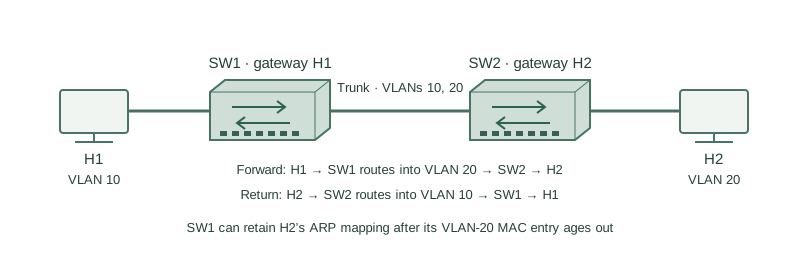
H1 in VLAN 10 uses SW1 as gateway. H2 in VLAN 20 uses SW2. The switches share a trunk. SW1 has already resolved H2, but H2’s return traffic is routed by SW2 into VLAN 10.
How it works
SW1 routes H1’s packet into VLAN 20 and sends an Ethernet frame toward H2’s MAC. SW2 delivers it locally. The reply reaches SW2’s gateway first, so SW2 routes it into VLAN 10; that reverse frame need not carry H2’s MAC through SW1 in VLAN 20.
MAC learning uses source addresses in each VLAN. Sending frames to H2 does not refresh H2’s source-MAC entry on SW1. When that entry ages out before the ARP entry, SW1 still knows the IP-to-MAC mapping but not the MAC-to-port mapping.
The result is unknown-unicast flooding within VLAN 20 on eligible forwarding ports. Ping may continue working, so success alone hides excess traffic. Compare the ARP and MAC tables on the switch that floods, then examine both traffic directions.
Configure or inspect
No feature change is required for this conceptual comparison. Inspect the operational state below on an isolated compatible lab platform.
Verify the result
SW1#show ip arp 192.168.20.20
Internet 192.168.20.20  15  0200.0000.0020 ARPA Vlan20
SW1#show mac address-table address 0200.0000.0020
Total Mac Addresses for this criterion: 0
SW1#show mac address-table aging-time vlan 20
Vlan 20: aging time 300 seconds
The remaining ARP entry does not prevent flooding because the Layer 2 destination lookup has no port result. The 300-second example is useful only after checking the actual platform and configured aging policy.
Failure and recovery
A long one-way transfer continues after H2’s MAC entry ages out on SW1, flooding copies to unrelated VLAN-20 ports.
Align gateway and forwarding design so return source learning reaches the relevant switch. Review FHRP/STP placement or routed-access alternatives. If tuning ARP/MAC aging is appropriate, follow the platform design guide and capacity limits; blindly extending MAC aging does not repair the asymmetric topology.
Further reading
Key Takeaways
- ARP and MAC tables answer different questions.
- MAC learning follows source frames.
- Asymmetry can prevent relevant source refresh.
- A working ping can coexist with flooding.
- Inspect both directions before tuning timers.