Collision domains
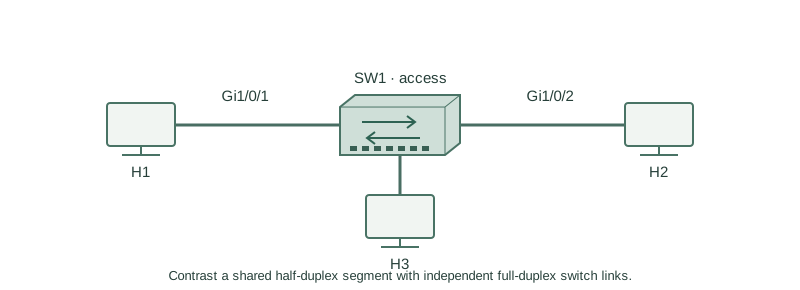
Contrast a shared half-duplex segment with independent full-duplex switch links.
Independent lab examples; selected output and frame summaries are illustrative. Port naming and command support vary by switch and software release.
Network and objective
Hub behavior is historical context; ordinary modern switched access is point-to-point full duplex.
H1 and H2 first share an old hub connected to SW1. In the replacement design each host has its own switch port.
How it works
A repeater hub repeats signals and leaves attached half-duplex stations sharing access to the same medium. Simultaneous transmissions can collide. CSMA/CD detects that event and coordinates backoff, not a forwarding-table lookup.
A switch terminates each physical link and can queue traffic toward an output. Separate full-duplex host links can transmit and receive simultaneously without CSMA/CD. The historical phrase one collision domain per switch port should not imply that collisions are normal on full-duplex Ethernet. VLANs partition broadcast domains, which is a different boundary.
Configure or inspect
show interfaces GigabitEthernet1/0/1
show interfaces GigabitEthernet1/0/2
Verify the result
SW1#show interfaces GigabitEthernet1/0/1
GigabitEthernet1/0/1 is up, line protocol is up
  Full-duplex, 1000Mb/s
  0 collisions, 0 late collision
Full duplex removes shared-medium collision arbitration; it does not eliminate queue contention or output drops when several inputs target one output.
Failure and recovery
Unexpected collision or late-collision counters on a legacy link call for checking duplex, cabling and both endpoints. A VLAN change cannot repair a duplex mismatch.
Use compatible negotiated settings and replace unsupported shared-media hardware where required; retest counter deltas.
Further reading
Key Takeaways
- A hub repeats signals within a shared segment.
- Half duplex uses contention and backoff.
- Full duplex does not use CSMA/CD.
- Switch queuing is not an Ethernet collision.
- Collision and broadcast domains are different concepts.