EtherChannel over Q-in-Q
Keep customer bundle members on separate provider circuits before transporting their negotiation.
Independent lab examples; selected output and frame summaries are illustrative. Port naming and command support vary by switch and software release.
Network and objective
This legacy-style example needs provider support for point-to-point Layer 2 protocol tunneling, including LACP. It is not a generic property of an arbitrary VLAN service.
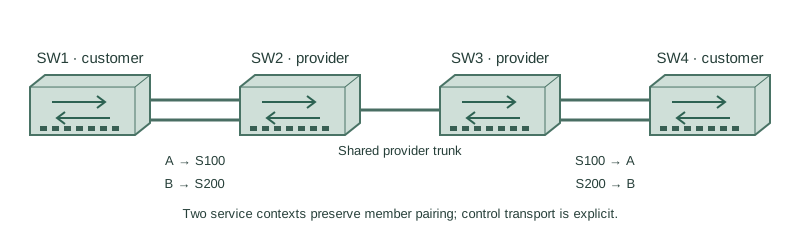
Customer SW1 and SW4 have two intended bundle members. Provider SW2/SW3 carry member A in service VLAN 100 and member B in 200. SW2/SW3 customer-facing Gi1/0/1 and /2 correspond one-to-one; /24 is the provider trunk.
How it works
One shared provider multipoint VLAN can mix the two member paths and break the customer’s assumption of separate links. Dedicated service contexts preserve the intended member pairing. Negotiate the customer bundle only when the service explicitly transports the required control frames.
Layer 2 protocol tunneling encapsulates selected control frames for transit. On scoped platforms the point-to-point LACP tunneling command is distinct from ordinary l2protocol-tunnel choices. Confirm the exact supported syntax, frame size, failure propagation and recovery contract before treating this as equivalent to two physical wires.
Configure or inspect
vlan 100
vlan 200
interface GigabitEthernet1/0/1
 switchport access vlan 100
 switchport mode dot1q-tunnel
 l2protocol-tunnel point-to-point lacp
interface GigabitEthernet1/0/2
 switchport access vlan 200
 switchport mode dot1q-tunnel
 l2protocol-tunnel point-to-point lacp
interface GigabitEthernet1/0/24
 switchport mode trunk
 switchport trunk allowed vlan 100,200
Verify the result
SW1#show etherchannel summary
Group  Port-channel  Protocol  Ports
1      Po1(SU)      LACP      Gi1/0/1(P) Gi1/0/2(P)
This is the expected customer result after both service edges and customer channel-group 1 mode active are configured consistently. P marks bundled members; it does not prove the provider will propagate every remote failure correctly.
Failure and recovery
If both customer members traverse one undifferentiated service VLAN, fix the circuit separation before forcing a static channel. Validate each member failure and restoration independently.
Restore service VLAN 100 to member A and VLAN 200 to member B at both provider edges, verify supported LACP tunneling, then test the customer bundle.
Further reading
Key Takeaways
- Separate service circuits preserve member pairing.
- Data tunneling alone does not guarantee LACP transport.
- Control tunneling syntax is platform-specific.
- Static bundling is not a repair for mixed paths.
- Test each remote member failure and recovery.