Flex Links
Recognize an explicit active/standby Layer 2 alternative with a restricted topology contract.
Independent lab examples; selected output and frame summaries are illustrative. Port naming and command support vary by switch and software release.
Network and objective
Legacy supported-platform recognition. Do not apply this recipe to the earlier STP triangle as a cumulative change.
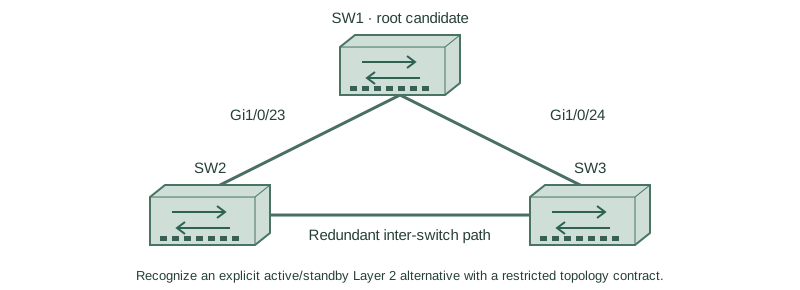
Use three fresh isolated switches with Gigabit trunks: SW1 Gi1/0/23 ↔ SW2 Gi1/0/23; SW1 Gi1/0/24 ↔ SW3 Gi1/0/24; SW2 Gi1/0/24 ↔ SW3 Gi1/0/23. Both VLANs10/20 exist on every switch. Baseline SW1/SW2/SW3 priorities are4096/8192/12288, with short costs and no extra links. Start independently from the included baseline for each lesson; subsequent repair snippets apply to the named device.
How it works
Legacy Flex Links pair an active interface with a standby that does not forward ordinary traffic until takeover. The paired links do not use normal STP participation for loop prevention. The topology must therefore be engineered so that activating either path cannot create another uncontrolled cycle.
Support, preemption, MAC-move behavior and VLAN balancing vary. Modern Flexlink+ is a separate feature with its own restrictions and should not be configured by copying an old command. This is historical recognition and a compatible-platform lab, not a universal recommendation to replace STP.
Configure or inspect
SW3 · compatible legacy platform only
vlan 10
interface range GigabitEthernet1/0/23 - 24
 switchport mode trunk
 switchport trunk allowed vlan 10
 no shutdown
exit
interface GigabitEthernet1/0/24
 switchport backup interface GigabitEthernet1/0/23
Verify the result
SW3#show interfaces switchport backup
Active Interface       Backup Interface       State
Gi1/0/24               Gi1/0/23               Active Up/Backup Standby
This standalone pair is not the earlier fully meshed STP triangle baseline. Keep only the documented two-uplink active/standby topology and compatible upstream service for this experiment.
Failure and recovery
If another unprotected Layer2 cycle exists upstream, a standby pair alone does not solve it. Validate the complete topology rather than treating the backup label as a global loop guarantee.
SW3
interface GigabitEthernet1/0/24
 no switchport backup interface
exit
spanning-tree mode rapid-pvst
Further reading
Key Takeaways
- Flex Links use an explicit active/standby pair.
- Normal STP protection is absent on the paired links.
- The entire topology must remain safe during takeover.
- Legacy Flex Links and Flexlink+ are distinct.
- Platform and release restrictions are essential.