Topology changes
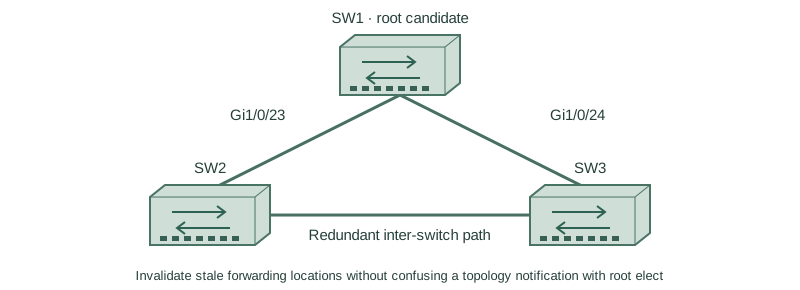
Invalidate stale forwarding locations without confusing a topology notification with root election.
Independent lab examples; selected output and frame summaries are illustrative. Port naming and command support vary by switch and software release.
Network and objective
Classic PVST+ is used to expose original STP behavior; rapid-PVST+ and MST are separate lessons.
Use three fresh isolated switches with Gigabit trunks: SW1 Gi1/0/23 ↔ SW2 Gi1/0/23; SW1 Gi1/0/24 ↔ SW3 Gi1/0/24; SW2 Gi1/0/24 ↔ SW3 Gi1/0/23. Both VLANs10/20 exist on every switch. Baseline SW1/SW2/SW3 priorities are4096/8192/12288, with short costs and no extra links. Start independently from the included baseline for each lesson; subsequent repair snippets apply to the named device.
How it works
When the forwarding topology changes, a previously learned MAC location may point along an obsolete path. Classic STP reports topology changes toward the root and propagates a topology-change indication. Switches temporarily accelerate dynamic aging rather than retaining every old destination for its ordinary lifetime.
In the classic model, affected switches can use the forward-delay value as the shortened aging time while the notification is active. RSTP uses different propagation/flushing rules. Repeated ordinary edge flaps should not keep disturbing the whole tree; correct edge classification avoids unnecessary topology changes.
Configure or inspect
SW1
vlan 10
vlan 20
spanning-tree mode pvst
spanning-tree pathcost method short
spanning-tree vlan 10 priority 4096
spanning-tree vlan 20 priority 4096
interface range GigabitEthernet1/0/23 - 24
 switchport mode trunk
 switchport trunk allowed vlan 10,20
 switchport nonegotiate
 no shutdown
exit
SW2
vlan 10
vlan 20
spanning-tree mode pvst
spanning-tree pathcost method short
spanning-tree vlan 10 priority 8192
spanning-tree vlan 20 priority 8192
interface range GigabitEthernet1/0/23 - 24
 switchport mode trunk
 switchport trunk allowed vlan 10,20
 switchport nonegotiate
 no shutdown
exit
SW3
vlan 10
vlan 20
spanning-tree mode pvst
spanning-tree pathcost method short
spanning-tree vlan 10 priority 12288
spanning-tree vlan 20 priority 12288
interface range GigabitEthernet1/0/23 - 24
 switchport mode trunk
 switchport trunk allowed vlan 10,20
 switchport nonegotiate
 no shutdown
exit
Verify the result
SW3#show spanning-tree vlan 10 detail
  Number of topology changes 3 last change occurred 00:00:12 ago
          from GigabitEthernet1/0/24
  Timers: hello 2, topology change 35, notification 2
SW3#show mac address-table dynamic vlan 10
  10 0200.0000.0011 DYNAMIC Gi1/0/24
Correlate the last-change interface and counter delta with the actual link event. A cumulative count alone does not demonstrate a continuing storm or identify its root cause.
Failure and recovery
Frequent host-link flaps on ports not classified as edge can cause repeated notifications and relearning. Repair the physical instability and use a correct host-edge policy; do not suppress control frames on uplinks.
Check the reported source interface, logs and link counters. Restore stable cabling first; apply PortFast only to verified endpoint attachments.
Further reading
Key Takeaways
- Topology changes affect forwarding-table validity.
- Classic notification travels toward the root.
- Classic aging and rapid flushing differ.
- Use event deltas and source interfaces.
- Unstable edge links should not be hidden by uplink filtering.