DTP negotiation
Predict dynamic trunk negotiation and replace it with explicit intent.
Independent lab examples; selected output and frame summaries are illustrative. Port naming and command support vary by switch and software release.
Network and objective
DTP is a proprietary switch feature, not an IEEE requirement. Defaults and supported modes vary.
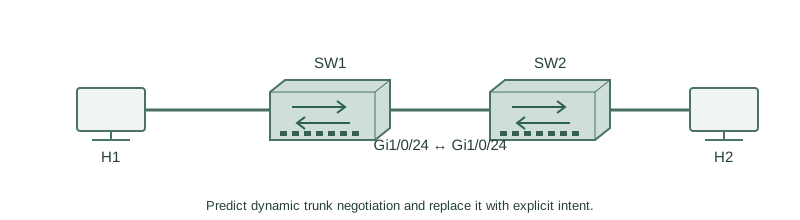
Use two fresh lab switches: H1 on SW1 Gi1/0/1, H2 on SW2 Gi1/0/1, and Gi1/0/24 between the switches. No other production links are connected.
How it works
Dynamic desirable actively negotiates a trunk; dynamic auto waits for a suitable peer. Auto plus auto normally remains access, whereas desirable plus auto can form a trunk. A statically forced trunk can still generate negotiation traffic unless it is suppressed on supporting platforms.
Use explicit access mode toward an endpoint and explicit trunk mode toward a known switch. Disable negotiation where supported. This removes reliance on an unknown neighbor asking for a trunk; it does not by itself implement host authentication or prune unnecessary VLANs.
Configure or inspect
interface GigabitEthernet1/0/24
 switchport mode dynamic auto
Verify the result
SW1#show interfaces GigabitEthernet1/0/24 switchport
Administrative Mode: dynamic auto
Operational Mode: static access
Negotiation of Trunking: On
SW2#show interfaces GigabitEthernet1/0/24 switchport
Administrative Mode: dynamic auto
Operational Mode: static access
Both sides waiting explains why the intended trunk never forms. This is a negotiation-mode problem even though the physical link may be connected.
Failure and recovery
For this intended uplink, configure trunk intent on both ends. On host-facing ports use static access instead. Do not enable desirable merely to make every unknown endpoint a potential trunk peer.
interface GigabitEthernet1/0/24
 switchport mode trunk
 switchport nonegotiate
end
show interfaces trunk
Further reading
Key Takeaways
- DTP is platform-specific.
- Auto plus auto normally remains access.
- Desirable actively negotiates.
- Static trunk and negotiation suppression are separate.
- Endpoint and uplink intent should be explicit.