BackboneFast
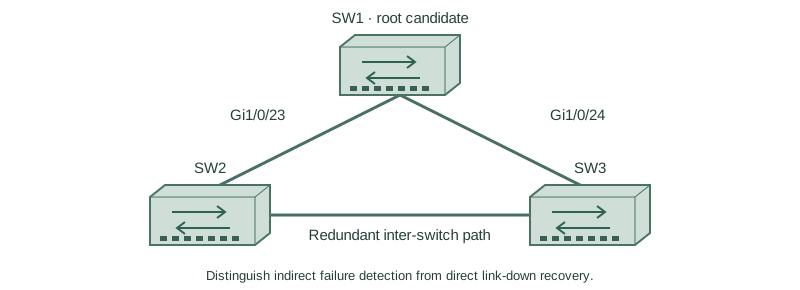
Distinguish indirect failure detection from direct link-down recovery.
Independent lab examples; selected output and frame summaries are illustrative. Port naming and command support vary by switch and software release.
Network and objective
Classic PVST+ is used to expose original STP behavior; rapid-PVST+ and MST are separate lessons.
Use three fresh isolated switches with Gigabit trunks: SW1 Gi1/0/23 ↔ SW2 Gi1/0/23; SW1 Gi1/0/24 ↔ SW3 Gi1/0/24; SW2 Gi1/0/24 ↔ SW3 Gi1/0/23. Both VLANs10/20 exist on every switch. Baseline SW1/SW2/SW3 priorities are4096/8192/12288, with short costs and no extra links. Start independently from the included baseline for each lesson; subsequent repair snippets apply to the named device.
How it works
An indirect failure can leave a blocked port holding superior old root information even though its neighbor now advertises an inferior root. Legacy BackboneFast uses root-link-query exchanges to determine whether the old root remains reachable and can avoid waiting the full max-age interval.
It does not eliminate the classic listening/learning intervals that follow path selection. Enable the supported legacy feature throughout the appropriate classic topology when reproducing the mechanism; RSTP uses different convergence behavior and does not need it as a universal extra.
Configure or inspect
SW1
vlan 10
vlan 20
spanning-tree mode pvst
spanning-tree pathcost method short
spanning-tree vlan 10 priority 4096
spanning-tree vlan 20 priority 4096
interface range GigabitEthernet1/0/23 - 24
 switchport mode trunk
 switchport trunk allowed vlan 10,20
 switchport nonegotiate
 no shutdown
exit
spanning-tree backbonefast
SW2
vlan 10
vlan 20
spanning-tree mode pvst
spanning-tree pathcost method short
spanning-tree vlan 10 priority 8192
spanning-tree vlan 20 priority 8192
interface range GigabitEthernet1/0/23 - 24
 switchport mode trunk
 switchport trunk allowed vlan 10,20
 switchport nonegotiate
 no shutdown
exit
spanning-tree backbonefast
SW3
vlan 10
vlan 20
spanning-tree mode pvst
spanning-tree pathcost method short
spanning-tree vlan 10 priority 12288
spanning-tree vlan 20 priority 12288
interface range GigabitEthernet1/0/23 - 24
 switchport mode trunk
 switchport trunk allowed vlan 10,20
 switchport nonegotiate
 no shutdown
exit
spanning-tree backbonefast
Verify the result
SW3#show spanning-tree backbonefast
BackboneFast is enabled
  RootLinkQuery request and reply counters are available on this platform.
Constructed event: SW1–SW2 fails; SW3 retains its direct path to SW1.
SW3 can detect that SW2’s new claim is inferior while still reaching SW1. The mechanism saves an aging wait; it does not promise zero-loss or instantaneous end-to-end recovery.
Failure and recovery
A directly failed SW3 root port is not the same exercise. Confirm which link failed and inspect the protocol mode before attributing recovery timing to BackboneFast.
SW1
no spanning-tree backbonefastSW2
no spanning-tree backbonefastSW3
no spanning-tree backbonefastFurther reading
Key Takeaways
- BackboneFast addresses indirect classic-STP failure.
- Inferior information can reveal lost root reachability.
- Root-link queries can avoid max-age waiting.
- Listening and learning can still follow.
- Rapid protocols use different mechanisms.