Power over Ethernet
Check both data connectivity and the electrical budget for powered endpoints.
Independent lab examples; selected output and frame summaries are illustrative. Port naming and command support vary by switch and software release.
Network and objective
PoE requires supported PSE hardware and compatible PDs. Standards, per-port limits, negotiation, and budget depend on the switch model and power supplies.
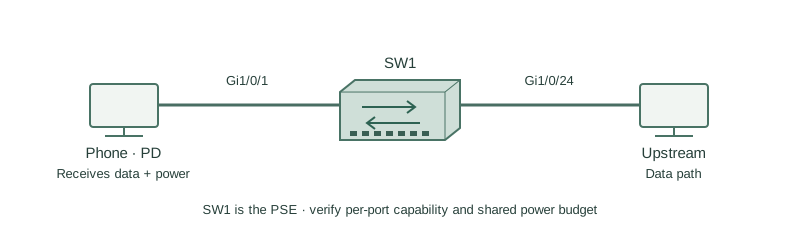
A phone on SW1 Gi1/0/1 is the powered device (PD). SW1 is the power sourcing equipment (PSE). An uplink can work normally while the phone remains off because power and data are separate resources.
How it works
An endspan supplies power from the switch; a standards-compliant midspan injector supplies power between a non-PoE switch and the endpoint. Detection/classification avoids applying negotiated standards-based power to an incompatible device. Passive injectors are a different design and can damage incompatible equipment.
Compare the PSE’s output rating with the guaranteed PD input after cable loss. Common maximum PSE/PD pairs are approximately 15.4/13 W for Type 1, 30/25.5 W for Type 2, 60/51 W for Type 3, and 90/71 W for Type 4. The actual class, cable, and platform limit determine usable power.
A switch may have enough per-port capability but insufficient total power for all connected devices. Inspect available, used, and remaining budget plus device classification. A device may boot in a reduced-function mode if it receives less power than its full feature set needs.
Configure or inspect
interface GigabitEthernet1/0/1
 power inline auto
Verify the result
SW1#show power inline
Available: 370.0(w)  Used: 30.0(w)  Remaining: 340.0(w)
Interface Admin Oper Power Device       Class Max
Gi1/0/1   auto  on   15.4  IP Phone     3     30.0
Gi1/0/2   auto  on   14.6  Access Point 3     30.0
The example totals add to 30.0 W; the Max column is not current consumption. Check the model-specific accounting method because allocated and measured power are not interchangeable on every platform.
Failure and recovery
A new high-power access point is denied power after the shared budget is exhausted, even though its Ethernet cable and port support the required speed.
Check PD requirements, cable quality, negotiated class, per-port cap, and total supply budget. Add supported power capacity or move the endpoint to an appropriate source; do not force unnegotiated power or exceed equipment ratings.
Further reading
Key Takeaways
- PSE supplies; PD consumes.
- Endspan and midspan place power differently.
- PSE output differs from PD received power.
- Per-port capability and total budget both matter.
- A working data link does not prove adequate power.