Rapid spanning tree
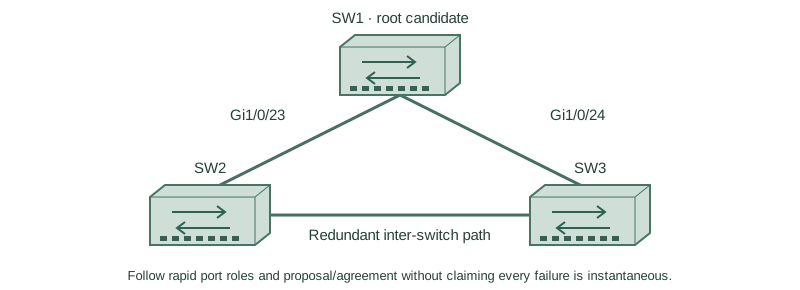
Follow rapid port roles and proposal/agreement without claiming every failure is instantaneous.
Independent lab examples; selected output and frame summaries are illustrative. Port naming and command support vary by switch and software release.
Network and objective
The lab uses rapid-PVST+, a per-VLAN implementation based on RSTP. IEEE RSTP and proprietary per-VLAN packaging should not be conflated.
Use three fresh isolated switches with Gigabit trunks: SW1 Gi1/0/23 ↔ SW2 Gi1/0/23; SW1 Gi1/0/24 ↔ SW3 Gi1/0/24; SW2 Gi1/0/24 ↔ SW3 Gi1/0/23. Both VLANs10/20 exist on every switch. Baseline SW1/SW2/SW3 priorities are4096/8192/12288, with short costs and no extra links. Start independently from the included baseline for each lesson; subsequent repair snippets apply to the named device.
How it works
RSTP has discarding, learning and forwarding states, with alternate and backup roles distinguishing standby paths. Bridges originate BPDUs and use received information to maintain their local view. Root selection still follows bridge identity and path preference.
A full-duplex point-to-point designated link can use proposal/agreement with synchronization of other relevant ports. Edge ports can forward immediately. Shared segments, legacy neighbors, failed handshakes and detection delays can require slower behavior; rapid is not a guaranteed millisecond outage specification.
Configure or inspect
SW1
vlan 10
vlan 20
spanning-tree mode rapid-pvst
spanning-tree pathcost method short
spanning-tree vlan 10 priority 4096
spanning-tree vlan 20 priority 4096
interface range GigabitEthernet1/0/23 - 24
 switchport mode trunk
 switchport trunk allowed vlan 10,20
 switchport nonegotiate
 no shutdown
exit
SW2
vlan 10
vlan 20
spanning-tree mode rapid-pvst
spanning-tree pathcost method short
spanning-tree vlan 10 priority 8192
spanning-tree vlan 20 priority 8192
interface range GigabitEthernet1/0/23 - 24
 switchport mode trunk
 switchport trunk allowed vlan 10,20
 switchport nonegotiate
 no shutdown
exit
SW3
vlan 10
vlan 20
spanning-tree mode rapid-pvst
spanning-tree pathcost method short
spanning-tree vlan 10 priority 12288
spanning-tree vlan 20 priority 12288
interface range GigabitEthernet1/0/23 - 24
 switchport mode trunk
 switchport trunk allowed vlan 10,20
 switchport nonegotiate
 no shutdown
exit
Verify the result
SW3#show spanning-tree vlan 10
VLAN0010
  Spanning tree enabled protocol rstp
Interface           Role Sts Cost Type
Gi1/0/24            Root FWD 4    P2p
Gi1/0/23            Altn BLK 4    P2p
The CLI may still abbreviate a discarding alternate as BLK. Protocol rstp identifies the rapid instance; the output abbreviation does not reintroduce classic listening as a separate rapid state.
Failure and recovery
A legacy neighbor can make one segment operate with compatibility behavior. Inspect detail and partner capabilities before lowering timers to force an unsafe result.
Restore compatible rapid settings where supported and intended, verify point-to-point/edge classification and retest a controlled link failure.
Further reading
Key Takeaways
- RSTP has three port states.
- Root selection principles remain.
- Proposal/agreement depends on link and synchronization conditions.
- Legacy/shared segments can slow recovery.
- CLI BLK can represent rapid discarding.