VTP version 3
Make database ownership explicit and compare extended feature support with older VTP.
Independent lab examples; selected output and frame summaries are illustrative. Port naming and command support vary by switch and software release.
Network and objective
Requires VTPv3-capable switches and supported feature databases. Primary status is operational and its persistence/recovery must be understood.
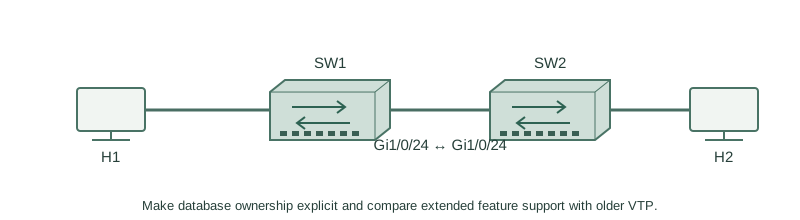
Use two fresh lab switches: H1 on SW1 Gi1/0/1, H2 on SW2 Gi1/0/1, and Gi1/0/24 between the switches. No other production links are connected.
How it works
VTPv3 adds a primary-server role for updating a feature database; other servers are not automatically writers. It can distribute extended VLAN/PVLAN information and, where supported, an MST database. These are distinct feature instances, not one universal configuration replication system.
Review domain, version, authentication and feature consistency before promoting a primary. VTP off differs from transparent forwarding behavior. Compatibility with older versions is constrained and must not be treated as unrestricted mixed-version synchronization. A primary writer reduces accidental changes but does not replace a validated change process.
Configure or inspect
SW2
vtp domain ROUTECRAFT-LAB
vtp version 3
vtp mode client
interface GigabitEthernet1/0/24
 switchport mode trunk
 switchport trunk allowed vlan 10,20,2010
 no shutdown
SW1
vtp domain ROUTECRAFT-LAB
vtp version 3
vtp mode server
interface GigabitEthernet1/0/24
 switchport mode trunk
 switchport trunk allowed vlan 10,20,2010
 no shutdown
end
vtp primary vlan
configure terminal
vlan 2010
 name EXTENDED-LAB
end
Verify the result
SW1#show vtp status
VTP version running             : 3
VTP Domain Name                 : ROUTECRAFT-LAB
Feature VLAN:
  VTP Operating Mode            : Primary Server
  Configuration Revision        : 1
SW2#show vlan id 2010
VLAN Name                             Status
2010 EXTENDED-LAB                     active
SW2 needs compatible VTPv3 domain/authentication, client or secondary-server role and trunk transport. Verify the actual extended VLAN rather than only the primary label.
Failure and recovery
A secondary server rejecting an attempted VLAN edit is not necessarily broken. Confirm which device is authorized to be primary and promote only during the planned change. Reloads or role transitions can change operational primary status.
Use the approved current primary, or deliberately promote the intended server after validating the existing database. Recheck the feature-specific status on every peer.
Further reading
Key Takeaways
- VTPv3 explicitly assigns the active writer.
- Feature databases have separate roles.
- Extended VLAN/PVLAN support depends on capability.
- Off and transparent are different choices.
- Primary role is not a substitute for change control.