Flood-and-Learn Multicast Data Plane
Use the IP multicast tree for BUM delivery and learn remote MAC locations from received data.
One RP, two leaf VTEPs
SPINE1 transports IP traffic and acts as the PIM sparse-mode RP at 10.255.0.1. LEAF1 and LEAF2 source VXLAN from 10.255.0.2 and .3. H1 is 10.10.10.11/24 and H2 is .22/24 on VLAN 10. The VNI is 10010 and its ASM group is 239.1.1.1.
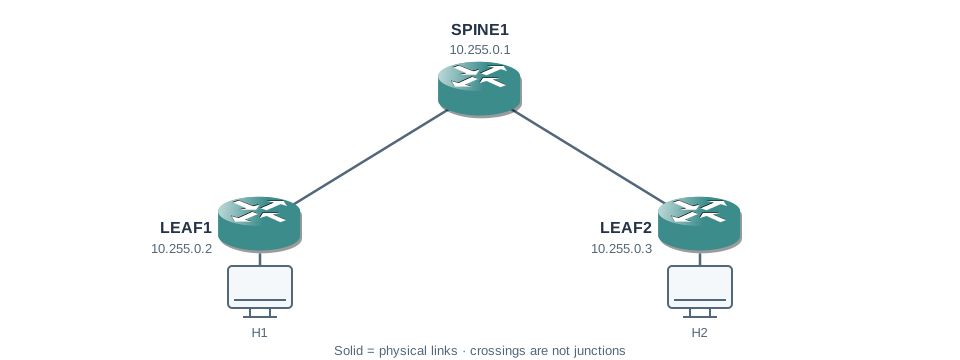
| Physical link | Address at first endpoint | Address at second endpoint |
|---|---|---|
| SPINE1 Ethernet1/1 ↔ LEAF1 Ethernet1/1 | 192.0.2.1/30 | 192.0.2.2/30 |
| SPINE1 Ethernet1/2 ↔ LEAF2 Ethernet1/1 | 192.0.2.5/30 | 192.0.2.6/30 |
| Device | Loopback0 / router ID |
|---|---|
| SPINE1 | 10.255.0.1/32 |
| LEAF1 | 10.255.0.2/32 |
| LEAF2 | 10.255.0.3/32 |
Unicast reachability and the RPF path
The independent recipe advertises every source loopback and routed link through OSPF. PIM reverse-path forwarding uses the unicast topology to decide the valid upstream direction toward a source or RP; multicast is not simply a second ordinary unicast route.
LEAF2# show ip route 10.255.0.1
10.255.0.1/32, ubest/mbest: 1/0
    *via 192.0.2.5, Eth1/1, [110/41], ospf-UNDERLAY, intra
Enable PIM and a common RP
All three switches · global multicast settings
feature pim
ip pim rp-address 10.255.0.1 group-list 239.1.1.0/24
Every transport-facing interface and loopback0
interface Ethernet1/1
  ip pim sparse-mode
interface loopback0
  ip pim sparse-mode
SPINE1 also enables PIM on Ethernet1/2. These are multicast additions to the complete OSPF configuration below. The group is in administratively scoped ASM space, not the 232/8 SSM range. SPINE1 is a single RP and therefore a deliberate redundancy limitation.
Associate VNI 10010 with the group
Both leaves · multicast NVE member
interface nve1
  no shutdown
  source-interface loopback0
  member vni 10010
    mcast-group 239.1.1.1
Both leaves also enable the overlay/VNI features, map VLAN 10 with vn-segment 10010 and attach H1/H2 to Ethernet1/2. The RP does not need a tenant VLAN or NVE interface. Only member VTEPs decapsulate; the VNI must still be valid locally even if several VNIs share a group.
Verify joins, forwarding and learning
LEAF1# show ip pim neighbor
Neighbor       Interface
192.0.2.1 Ethernet1/1SPINE1# show ip mroute 239.1.1.1
(*, 239.1.1.1), RP 10.255.0.1
Incoming interface: loopback0
Outgoing interface list: Ethernet1/1, Ethernet1/2
(10.255.0.2, 239.1.1.1)
Incoming interface: Ethernet1/1
Outgoing interface list: Ethernet1/2This reduced example is a possible shared-tree/source-state snapshot after traffic, not an exact timer transcript. Verify the active source, RPF interface and receiver-facing outgoing list for the live stage. A PIM neighbor alone does not prove group forwarding.
Trace request, reply and subsequent data
Outer IP: 10.255.0.2 -> 239.1.1.1
UDP destination: 4789; VNI: 10010
Inner Ethernet: H1 MAC -> broadcast
Remote leaf learns H1 MAC -> VTEP 10.255.0.2Outer IP: 10.255.0.3 -> 10.255.0.2
Inner Ethernet: H2 MAC -> H1 MAC
Return source learning: H2 MAC -> VTEP 10.255.0.3BUM uses the multicast tree; learned unicast can use a direct unicast outer destination. An ARP reply is not required to return to the multicast group merely because its request used that group.
When transport works but flooding does not
If host ARP fails while VTEP pings work, inspect the VNI/group mapping, RP selection, PIM neighbors, RPF and outgoing receiver interfaces. Correct a wrong mcast-group to 239.1.1.1 on the affected leaf; restore PIM sparse mode on any missing transport interface, then repeat a fresh ARP and end-host ping. Do not suppress flooding before a replacement discovery mechanism exists.
Complete independent lab configurations
Start with clean isolated lab devices. These are the complete scenario configurations, not changes to apply on top of a different lesson. Physical ports must match the address table. Virtual-image data-plane capabilities can differ from physical switches; these examples have not been executed on live devices.
Download configuration reference
SPINE1
hostname SPINE1
feature ospf
feature pim
ip pim rp-address 10.255.0.1 group-list 239.1.1.0/24
router ospf UNDERLAY
  router-id 10.255.0.1
interface loopback0
  ip address 10.255.0.1/32
  ip router ospf UNDERLAY area 0.0.0.0
  ip pim sparse-mode
interface Ethernet1/1
  no switchport
  mtu 9216
  ip address 192.0.2.1/30
  ip ospf network point-to-point
  ip ospf cost 40
  ip router ospf UNDERLAY area 0.0.0.0
  ip pim sparse-mode
  no shutdown
interface Ethernet1/2
  no switchport
  mtu 9216
  ip address 192.0.2.5/30
  ip ospf network point-to-point
  ip ospf cost 40
  ip router ospf UNDERLAY area 0.0.0.0
  ip pim sparse-mode
  no shutdown
LEAF1
hostname LEAF1
feature ospf
feature pim
ip pim rp-address 10.255.0.1 group-list 239.1.1.0/24
router ospf UNDERLAY
  router-id 10.255.0.2
interface loopback0
  ip address 10.255.0.2/32
  ip router ospf UNDERLAY area 0.0.0.0
  ip pim sparse-mode
interface Ethernet1/1
  no switchport
  mtu 9216
  ip address 192.0.2.2/30
  ip ospf network point-to-point
  ip ospf cost 40
  ip router ospf UNDERLAY area 0.0.0.0
  ip pim sparse-mode
  no shutdown
feature nv overlay
feature vn-segment-vlan-based
vlan 10
  vn-segment 10010
interface Ethernet1/2
  switchport
  switchport mode access
  switchport access vlan 10
  spanning-tree port type edge
  no shutdown
interface nve1
  no shutdown
  source-interface loopback0
  member vni 10010
    mcast-group 239.1.1.1
LEAF2
hostname LEAF2
feature ospf
feature pim
ip pim rp-address 10.255.0.1 group-list 239.1.1.0/24
router ospf UNDERLAY
  router-id 10.255.0.3
interface loopback0
  ip address 10.255.0.3/32
  ip router ospf UNDERLAY area 0.0.0.0
  ip pim sparse-mode
interface Ethernet1/1
  no switchport
  mtu 9216
  ip address 192.0.2.6/30
  ip ospf network point-to-point
  ip ospf cost 40
  ip router ospf UNDERLAY area 0.0.0.0
  ip pim sparse-mode
  no shutdown
feature nv overlay
feature vn-segment-vlan-based
vlan 10
  vn-segment 10010
interface Ethernet1/2
  switchport
  switchport mode access
  switchport access vlan 10
  spanning-tree port type edge
  no shutdown
interface nve1
  no shutdown
  source-interface loopback0
  member vni 10010
mcast-group 239.1.1.1| Host | Address | Gateway |
|---|---|---|
| H1 | 10.10.10.11/24 | none |
| H2 | 10.10.10.22/24 | none |
Further reading
Key Takeaways
- Multicast VXLAN maps a VNI’s BUM traffic to a group.
- Unicast routing supplies the source/RP reverse-path information.
- PIM joins and receiver forwarding state matter beyond neighbor adjacency.
- Remote source MACs can be learned from received VXLAN data.
- Learned unicast need not follow the multicast tree.